Showing posts with label writing. Show all posts

Wednesday, May 3, 2023

Tips to encourage your children to become natural writers

Image of a child's hand holding a pencil and writing on paper with text overlay that says Tips to encourage your children to become natural writers
A version of this post first appeared on my original blog, M and J in a Nutshell. On that blog, I documented a variety of things, but I kept a strong focus on education and homeschooling. This post features several updates.
 
Many children, including mine, don't have a natural enthusiasm for writing. For years, it was a chore to get my now adult child to write anything that wasn't absolutely necessary. By the time my child was 13 years old, however, they were writing every day -- and without prompting or instruction from me.
 
So, what changed? Did I force my child to sit and write daily? No. Did some other teacher or tutor make my kiddo write every day? 
 
No. Instead, I changed a few of our family habits and my approach to teaching my homechooled child to write. I believe some of our initial struggles stemmed from a rigid writing curriculum used by my child's school district prior to our switch to homeschooling and due to my child's predisposition towards extreme rule following. We switched from public school to homeschooling halfway through fourth grade and it was a game changer.
 
While we used some specific writing, grammar, and general Language Arts curriculum in our homeschool program, the most effective things have been the least academic.

Here are some tips, based on our experiences, that might help your child become a better or more engaged writer:
 
First, make sure your children have the tools to write! And, make those items as easily accessible as possible for your children. As obvious as this may seem, I am amazed when I arrive to tutor a student and there are no pens or pencils to be seen. No paper. No notebooks. Nothing...how is one to write without the tools? 
 
Put out a pencil or pen jar, a tub of fun erasers, and a pile of notebooks or paper. Make it easily accessible. And, those pages that you print off, then toss away? If the other side is blank, put it in a box for scratch paper -- my child frequently used such paper for sketching out new ideas or making notes.
 
You can even go a step further and have your child help to decorate containers to hold their pens, pencils, and paper. Let them use fun pencils or pens. Let them use color! This is non-academic writing, so color and fun can be part of the process.

Writing and art supplies on top of a small cabinet.
 
Provide a variety of notebooks from basic lined notebooks to fun, colorful journals, and even sketchpad style notebooks. July and August are a great time to stock up on notebooks, journals, and writing supplies since most stores will have great back-to-school sales! You should be able to find a wide selection of notebooks, pens and pencils at very low cost. Notebooks are great for journaling, writing stories, keeping lists, and more.

As an avid writer of letters, and with several pen-pals throughout the world, I am often asked about finding pen-pals for children. Honestly, I think it is a great idea, but children don't make very good pen-pals without extensive parental involvement and encouragement. Most of the time it is the parent who wants their child to have a pen-pal, and the child has little interest. Wait until your child is asking on their own about pen-pals, then investigate options. That said, I do have a few tips on encouraging children to write snail-mail letters...

Get a fun, colorful box and fill it with cute stationery and postcards. The local dollar store usually has a good selection at a low price. Even better, take your child to pick out their own stationery! Your computer also probably has some cute fonts, backgrounds, and clip art to create your own. When you see a rack of postcards, buy some! Anytime you travel, be sure to pick up postcards too. 
 
Have your kids use the stationery and postcards to write to grandparents, aunts and uncles, and even to you. Have them write silly notes to their best friend or the child that lives next door. Your kids are more likely to keep writing to these people than to a stranger from a pen-pal exchange. If your kids are writing to friends and family that live nearby, you don't even need to mail the cards and letters. Have your kids walk next door or take them with you to deliver their notes in person. Your kids will love seeing the faces of their friends and family light up with joy...and, they will be encouraged to write another letter or postcard!

Our family mailbox...I don't recall where we found it!
 
Set up a family mailbox. This can be just an empty shoe box, or you can go all out and buy an actual mailbox at the local hardware store! Set it somewhere easily accessible to everyone in the family, and let the kids decorate it. Whenever they have something to tell you, but for some reason they don't want to just say it, they can write a note and put it in the mailbox. This is fun for sharing jokes, silly secrets, or a simple "I love you", but it can also be helpful for starting difficult conversations too.


These are fun ways to engage your child in writing, without the stress of academic assignments. 
 
The key to having your child continue writing is to be non-critical of fun, non-academic writing. Your child's spelling, grammar, and content will all be addressed by their teacher or when you go over their schoolwork. Your child's journal, letters, postcards, and notes are informal expressions that they put their heart into. Expect them to make mistakes, but also expect the lessons from school to eventually work their way into their informal writing. 
 
Be supportive and encouraging so that they keep it up for a lifetime!
 
Are your children natural writers? What have been their best and worst writing experiences?
 
Interested in buying a family mailbox? Check out the options below from Amazon! Please note, these are affiliate links and may result in a small commission for me if you purchase through them -- thank you in advance.



Wednesday, August 2, 2017

You, your child, and poetry read alouds

Mom2MomEd Blog: You, your kids, and poetry read alouds
If you've been following along with Mom2MomEd for any length of time, you'll surely be aware that we love reading. We also love reading aloud with our children--my son is 18 and I still enjoy reading aloud with him!

After I began homeschooling my son, halfway through his fourth grade year, we took our reading aloud to a new level and started a loose tradition of reading poetry and classic novels together during and after dinner. We didn't necessarily do this every night, but it did happen at least two or three times per week for a few years.

Reading aloud was special in our home for many reasons, but I especially cherish our loose tradition because it allowed my son and my mom to form a bond they might not have had otherwise. You see, I was a single mother and, for a time, we couldn't afford to live in our own place. As such, we moved in with my mom--my son's grandmother. My mom is pretty old school (no pun intended) when it comes to certain things related to children. This includes the idea that children should be seen and not heard. It also involves children always following directions from adults. My mom was a kindergarten teacher, and although she was beloved by her students and their families, my son and my mom had a rocky relationship.

Since we lived with my mom, my son and I often ate dinner with her, and thus we included her in many of our evening read aloud sessions. The three of us especially enjoyed reading poetry together. A couple of times per month, my son and I would go to the library, and among all of the books in our library haul, we'd each have a few books of poetry to share at the dinner table.

Since my son and my mom often had difficulty getting along--my mom wanting my son to be quieter and more compliant and my son wanting to ask questions and to explore and discuss the world around him--reading aloud together helped to bridge the gap.

We especially loved to take turns as we read. Often we would each read a poem aloud, passing the book at hand around the table several times so that we'd each read several pieces. Some nights we'd only spend 10 or 15 minutes reading to one another. On other nights, nights when we were all in particularly good moods or just really enjoying the material before us, we might sit at the table reading aloud for more than an hour.

There are many ways that you can encourage your kids to read more, but reading aloud with them is a surefire way to lead by example and spark a passion for books.

Over time, my son and I (and my mom) found that we drifted back to a few poets and collections of poetry over and over, eventually adding them to our own home libraries. We would love for you to visit your town or city's library and check out books and explore the world of literature, but we've also provided links below to several of our favorite poetry collections:

First we have two collections of classics:
 Mom2MomED: Poetry for children

And, then there are those classics that many parents of my generation grew up with--the mostly silly but sometimes serious works of Shel Silverstein:
Mom2MomEd: Children and Poetry
But then there are a huge number of terrific poetry collections and books that my son and I discovered through our evening read alouds and the local library. I encourage you to look for and enjoy these as well:
  • Collected Poems for Children by Ted Hughes--Hughes is best known as the ex-husband of poet Sylvia Plath and most of his work is most appropriate for adults. This collection, however, is terrific for kids.
Mom2MomEd: Poetry is good for a child's soul
One of our favorite poetry books turned out to be a double duty find. We were able to combine punctuation practice with reading and poetry in Punctuation Celebration by Elsa Knight Bruno. I was expecting this cute little collection to be dry and boring, but we loved it!
And, finally, we loved all of these fun little books--even though my son is 18 now, we still have a few of these in our home library, and every now and then, I catch my son still pulling them out! How's that for an endorsement?
While my little family of myself, my son, and my mom enjoyed reading aloud to one another at the dinner table, there are many ways you can encourage your kids to read more--we hope a read aloud session is just one of many methods you will use to increase the reading that happens in your home. 
No one--child or adult alike--is ever too old to read aloud or to be read to. Grab your family and a giant stack of pillows and make yourselves cozy on the living room floor if reading over dinner isn't your style.
Pitch a tent in the backyard, fill it with sleeping bags, stuffed animals, and a lantern and add several stacks of books for a Friday night read along.
Snuggle up with the family pets and take turns reading to Fido and Fluffy.
However you do it, keep reading to each other and simply enjoy the process of bonding over books. 
What's your favorite book to read aloud? Tell us about it in a comment!
Did you enjoy this post? Be sure to check out these additional articles:
http://mom2momed.blogspot.com/2016/08/thoughts-and-tips-on-building-family-of.html
http://mom2momed.blogspot.com/2016/10/alphabet-scavenger-hunt.html
http://mom2momed.blogspot.com/2017/04/teaching-your-kids-to-type.html

Please note, this post does contain affiliate links. If you purchase through these links, we may receive a small commission at no extra cost to you. Thank you for your support.

Friday, April 7, 2017

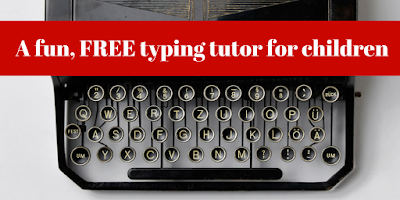
A fun, FREE typing program for children

Mom2MomEd: A fun, FREE typing program for children
I'm willing to bet that your children have quite a bit of experience using technology--even if they are only toddlers! They've probably already spent some time typing on a keyboard and can likely navigate a tablet almost as well as (or maybe even better!) you.

But, when your child is plucking away on a keyboard, are they just pecking at the keys or letters and numbers with their pointer fingers? If so, you might want to start encouraging them to develop proper typing skills.

Why does this matter?

In the many years that I have been a tutor and teacher, I've noticed that the kids who learn to type properly are able to complete their work more quickly and with fewer mistakes. They also are able to process information mentally more efficiently because they don't have to waste mental energy on the act of typing--they free up brain power for learning. They also develop a skill than will help them in any number of future endeavors ranging from simply playing a game online with friends to writing an important report at work. 

I taught my son, JP, to type at age 5 and now, at age 18, his typing speed is well over mine. We both took typing tests last week, and my speed was 94 words per minute after adjusting for errors. Pretty good, right? My son blew me away with an adjusted typing speed of nearly 120 words per minute!

So, how did I teach him to type properly?

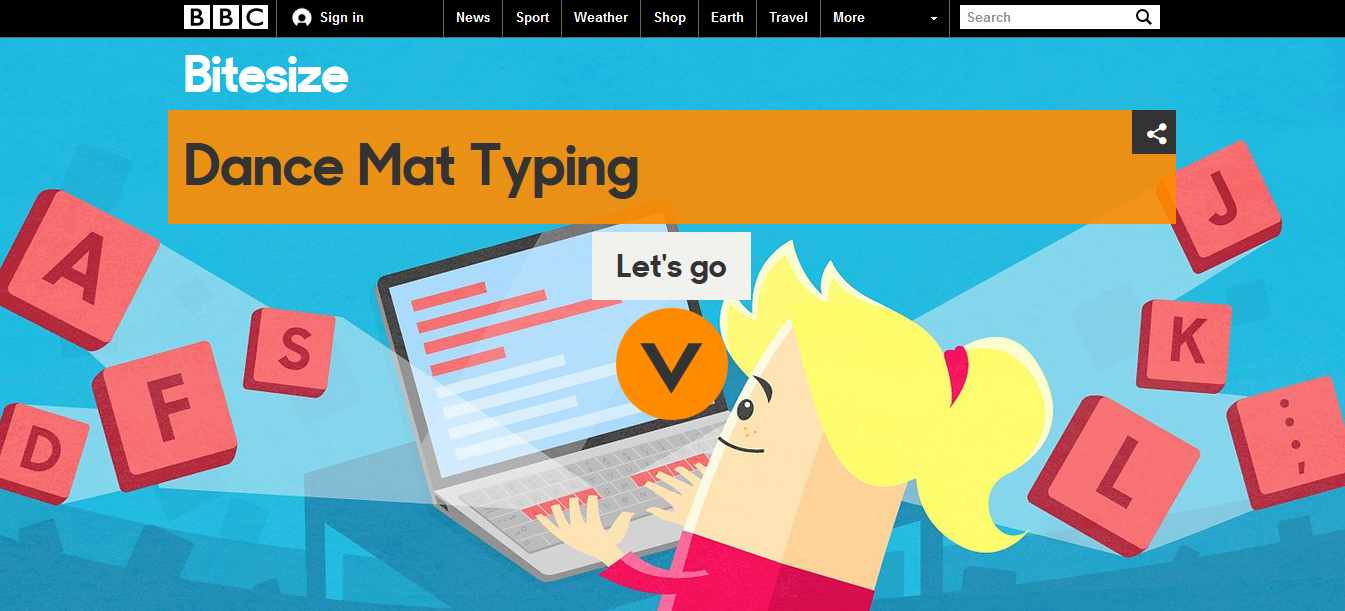
We used a little online program called Dance Mat Typing. This is a completely free, fully online typing program from BBC Bitesize, an educational website from the BBC. The program is fun and cute with lots of little animals and sound effects. 
Your kids will learn which keys should be pressed with which fingers, and where their hands should sit on the keyboard. They can practice a number of drills, starting with super simple combinations and working their way up through a few different levels.
Now, Dance Mat Typing is not a comprehensive typing program and does leave a lot to be desired, but overall it's a great starting point! I had my son start out with just a few minutes per day, repeating several segments over the course of several days, and eventually he was able to learn the key strokes and correct typing skills. From there, he was able to start using a computer keyboard properly and his speed and overall typing skills increased at a fast rate, naturally, since he had the basics nailed down.

Here are a few additional screen shots of the program:
You can check out Dance Mat Typing HERE. Be sure to come back and let us know what you think of it and if your kids benefit from it! 
Did you enjoy this post? Check out these additional articles:
http://mom2momed.blogspot.com/2016/07/parenting-my-spirited-child-can-you.html


Monday, January 23, 2017

3 tips to encouarge your children to write more


Mom2MomEd Blog: 3 tips to encourage your children to write more
"My hand hurts."
"I don't know what to write."

"This is boring."
"It takes too long."
"Can't I just tell you?"


These are but a few of the complaints and questions I get when tutoring children who dislike writing. As a writer and an educator, these pain me, but I hear these complaints regularly from students. I also hear frustration from parents and other educators frequently about the struggle to get their children, particularly boys, to write more...or to write legibly.

We have discussed some related issues previously in posts about the book The Trouble with Boys by Peg Tyre, but I wanted to dive into some specific tips and ideas to help you encourage the children in your life to write more.

First, you should know that my own son and I were not immune to these issues.


My son used to HATE writing--H. A. T. E. it! In part, he wasn't ready for the fine motor skills required to hold a standard pencil properly; however, he also had medical issues involving his vision that made writing difficult, and once he entered elementary school, the school district's curriculum didn't jive with my son's academic abilities or thought processes at all.

When it came to writing as a child, my son was a mess.

Now, years later, my son LOVES to write. He writes nearly daily and often for a few hours at a time...entirely by choice.

So, what changed?

Did I force him to sit and work on his handwriting and his composition skills? Not for long...
Did I hire a tutor or ask for after school help from his teacher? Nope (but for some families tutoring can help!)
Did I make him stick to the school curriculum? Nuh-uh (although your child should still do their schoolwork and study...my son did, but we also did a lot of other stuff!)

I didn't really do any of the above, or at least not for long.

Here are three easy ways to help your child with writing...I can't guarantee that your child will love to write, as mine now does, but I do believe these tips can help reduce the stress and frustration around writing (and we'll be sharing a lot more tips in the future!): 

1. Incorporate lots of reading
Yep, my first tip isn't even advice on actually writing! Instead, before your child can become a better writer, your kiddo needs to be a better reader. Quite simply, reading sets up the foundations for writing. Without language skills obtained from reading, writing will be difficult.

You can read to your child, with your child, or have your child read to you. Take turns reading. Have your child read to pets. Let your child bounce on a big exercise ball while reading. Let him hop on one foot while reading, if that's what he wants to do. Let her read curled up on the floor of her closet with a blanket, pillows, and a flashlight if that feels right for her. 

Just get reading into your child's life as much as possible!!!

Be sure to check out THESE posts for tons of tips on helping your children with reading (as well as advice on reading for yourself too!).

2. Get a family mailbox
Invest in a family mailbox--it could be an actual mailbox, a decorative small mailbox, a container with cubbies for everyone in the family, or even just a shoe box that you and your child decorate together.

Put the mailbox in a prominent place in the house where everyone can easily access it. Place some cute stationery and pens or pencils next to the mailbox and take turns writing notes and letters to one another. Make it a point to do this on a regular basis--even put it on the calendar!

Your child may start with brief, one sentence notes, and that's perfectly OK! Don't correct spelling or grammar in these notes and letters and don't make any comments about penmanship. The goal is simply to encourage the act of writing--the goal is NOT to perfect it! Over time, your child may start writing longer letters with more meaningful content.

A nice side bonus of the family mailbox is that your child may tell you things in writing that he or she doesn't feel comfortable telling you face-to-face. You may learn a lot about your child and you may see your relationship with your child grow thanks to your family mailbox!

We had a family mailbox very similar to THIS one (or click on the image below).
http://amzn.to/2kjBzQK
3. Keep writing tools easily accessible
It should seem obvious, but your child can't write if they don't have easy access to writing tools! It always amazes me, but I have arrived at many tutoring sessions only to find that not only has my student not brought paper or pens or pencils, but they don't even have any at home!

Hit up the local dollar store for some cheap pens, pencils, paper, and stationery. Grab some lined notebooks or pads of paper and fun erasers. Pop the pens and pencils into a cute jar or fun pencil pouch and set a pile on the kitchen table, coffee table, next to your child's bed, or even in the bathroom within reach of the toilet!

Have writing supplies out and easily accessible, and occasionally do a sweep of the house to gather supplies that may have scattered and return them to their homes. 

Don't necessarily pressure your child to write, but make sure the opportunity to do so is always easily available. A bored child sitting on a toilet may pick up pencil and paper or a kiddo waiting on a snack may decide to practice writing her name.

As I mentioned, the goal here is NOT perfection but rather simple, and gentle, encouragement. Children mature at different rates and if your child is struggling with writing, there may be a valid reason. I mentioned my son's struggles with writing, and I've encountered many other kids with similar issues.

Be sure to check back for more writing tips in the future!

In the meantime, leave a comment and let us know how you have encouraged your kids to write or what struggles your child is facing when it comes to getting words on paper.
Did you enjoy this post? Be sure to check out these additional blog articles:
http://mom2momed.blogspot.com/2016/12/10-things-i-got-right.html

http://mom2momed.blogspot.com/search/label/talking%20to%20your%20children

 http://mom2momed.blogspot.com/2016/11/how-real-moms-get-it-all-done.html


Make sure to follow us on Facebook for additional fun!
http://www.facebook.com/mom2momed

This post contains affiliate links.